15 May 2008
I made my annual pilgrimage to Cyprus where I have taught for the lost 10 years or so. This time I gave my lectures to the local technical Institute (ETEK) as well as addressing the Cyprus branch of The Arbitration Club.
21 April 2008
I was admitted as a day patient to Bury Hospital, for a nerve block in my neck. Not a very pleasant procedure but hopefully it will sort out my neck pain.
10 April 2008
Alice joined me in my consultation with Professor Leigh at Kings College Hospital. I must say the Professor was very charming and gave us two hours of his valuable time.
He agreed with the diagnosis of MND and said, encouragingly, that there was no definite upper motor neurone signs… which is the case in 10 -20% of patients presenting with MND. He wondered whether I would develop “flail arm†syndrome, which often spares the cranial nerves and the legs, for many months, or even years.
I suppose I was meant to take these comments as encouraging. In other words, although I might lose the use of my hands and arms I could live for some considerable time in this helpless state!!
Whilst generally confirming the neurologist’s diagnosis, Professor Leigh concluded that he saw this as a lower form of MND , not strictly speaking falling within the rubric of amyotropic lateral sclerosis (ALS)…. Lower MN do tend to be associated with the better prognosis, and of course, he has no evidence of respiratory muscle involvement, also indicative of a better prognosis.
He referred me to an MND support unit at Addenbrookes Hospital, in Cambridge.
20 March 2008
The neurologist wrote to Professor Leigh, at Kings College Hospital, and said inter alia:
“My 15th February examination revealed widespread fasciculation’s, bilaterally in the upper body and in the thigh, but to a lesser extent.
His neorophysiology demonstrated widespread ongoing denervation with fasciculations including the axial muscles. I have subsequently discussed the findings with (a colleague) who confirmed the findings. Whilst the most likely diagnosis is motor neurone disease, I recommended found the investigations to exclude other diagnoses
On cranial nerve examination, the palate moved freely. There was no fasciculations of the tongue. Time strength was intact. There was no evidence of any bulbar abnormality. His neck flexion was 5/5.
He has wasting also need deltoids bilaturally and on the left biceps and triceps and to a lesser degree muscles of the left forearm. On examination, he had weakness of shoulder abduction,4 on the left, 4+ on the right. The right arm was otherwise normal with the left arm grade 4 triceps and biceps the left hand was globally 4 again. Infraspinatus and supraspinatus were 4 on the left. Reflexes are+ throughout. Sensation is intact. In the lower limbs, there was a hint of weakness of left hip flexion. The rest of the appeared intact. Reflexes were present in, the knees, absent in the ankles. Plantars were going down. There was a reduction in vibration on the right to the ankle but intact to the left. Pinprick was intact. Chest examination was normal with good diaphragmatic movements. Abdominal examination was unremarkable and there was no hepatomegaly.”
It was as a result of this that I had the MRI scan, the lumbar puncture and blood tests.
The neurologist concluded his letter to Professor Leigh by recording that he had seen me and Alice on the 21st February and confirmed his belief that the diagnosis of Motor Neurone Disease was firm.
28 February 2008
On 28 February I flew off to Australia, determining to enjoy life while I could. The future was clearly pretty bleak. I stayed with my dear old friend (Dr.) Michael Long as well as spending a few days with some other old friends in Barwon Heads – Geoff. and Anne Waite.
One day, during this trip, I was invited to play golf at my old club, Kingston Heath. I was terribly excited about the idea having been a member there 50 years or so earlier.
Sadly it turned out to be a disaster. Not only was the temperature almost 40°C but after nine holes I was in such agony, from the pain in my groin that I could not move without severe pain. I spent the next hour sitting in one of the many wooden shelters on the course before I could comfortably move back to the clubhouse. Whatever the doctors say, hernia or not, there is something seriously wrong.
Apart from Michael being astonished at the violence on the fasciculations in my thighs there were no other medical ramification during this visit.
24 February 2008
A beautiful spring day, I played golf in the annual geriatric match over 65’s against the under 65’s. We had a usual problem of finding enough members to play in the under 65’s team.
Unfortunately I was unable to continue past the 15th hole. I had the most excruciatingly burning pain in my groin, in the same place as before, under the scar tissue from the artificial urinary sphincter operation. I’d had mild burning attacks before but this was unbelievable. What was rather distressing was that I had been signed off by a general surgeon, barely a week ago, who inspected this site and dismissed the idea of a hernia, followed by the neurologist who also examined me and found nothing untoward. This was followed by the radiologist who carried out the ultrasound who also said he could find nothing amiss. This made the whole thing more of a mystery and not a little worrying as I had no intention of delaying my departure to Australia.
I telephoned my old urologist who had carried out my radical prostatectomy, in 2000. It seems that he had come across this problem before – something to do with a trapped nerve end – and he kindly prescribed some pills over the telephone. I shall take them with me to Australia and pray that they work. In any event, there is always my host surgeon Michael, if there’s any cutting to be done!
23 February 2008
Smiler, Kimberley (Son and daughter-in-law), Chloe, Karl (daughter and son-in-law) and the grand children all came down today for lunch which cheered me up no end.
The Volz’s left after tea but the newlyweds stayed for supper. It was lovely to see them all before I headed off down under.
22 February 2008
My day did not start on a high note when I received a telephone call from BUPA saying that as I had been diagnosed with a chronic terminal condition I was no longer covered by my medical insurance. That in itself was something of a shock. The explanation they gave was that they could not afford to cover chronic conditions but only things that could be treated. As there was no treatment or cure for MND, that was that. However, as they accepted that I had had a less than satisfactory BUPA check up they agreed that they would cover me for consultations and treatment for the first three months, after that I would be thrown onto the NHS.
This at least meant they were prepared to cover the cost of the first fortnight’s tablets at £363.
I telephoned Professor Nigel Leigh and he kindly agreed to see me in early April on my return from Australia.
Now I could concentrate on thinking about my Australian trip starting next Thursday.
21 February 2008
No breakfast and gallons of water later I was sent for an abdominal ultrasound scan and some liver tests. Following the test I understood from the radiologist that there did not appear to be anything abnormal, at least not with the liver.
Between the early-morning tests and the evening consultation with the neurologist I went out and had a cracking lunch of lobster and champagne, at Sheekey’s, one of my favourite restaurants, with my dear old friend Geoffrey Hanscomb. That put me in the right frame of mind to hear the worst, whilst still hoping for the best.
That evening, ‘my lovely’ (Alice, my wife) met me at the Café Rouge for a little more champagne and a light snack before our meeting with the neurologist for the moment of truth. I had previously told him that whatever he had to say, provided I had more than a month to live I intended to go to Australia whatever. I was, of course, putting on a great show of bravado whilst at the same time feeling very apprehensive.
In the event, the Dr. confirmed, what I had feared all along, that all the indications were that I was suffering from some form of Motor Neurone disease (MND) or something allied to it.
This is what I had suspected, having looked up the symptoms on the Internet. I read that MND refers to a group of diseases which affect the motor neurones which are the cells that control voluntary muscle activity such as speaking, walking, breathing and swallowing. The prognosis, in any event, was not good. There are broadly four various types of MND.
Most cases of MND progress quite quickly with noticeable decline over the course of months. Symptoms may present in one region and they will typically spread. MND, it said, is typically fatal within 2-5 years, with around 50% of patients dying within 14 months of diagnosis. One in five patients may survive for five years and one in 10 for 10 years. Â Mortality normally results when control of the diaphragm is impaired and the ability to breath is lost.
The worst of the four forms of MND being ASL – that is when MND is the presence of both upper and lower motor neurones.
The other three are primary natural sclerosis (PLS) ; progressive muscular atrophy (PMA) and bulbar -pseudobulbar palsy – spastic and progressive bulbar palsy -spastic and flaccid, appear to be less serious inasmuch as one might live a little longer. No treatment is currently effective for any of these conditions. Although the use of a drug (Riluzule) , in the case of ALS, can extend the lifespan of a patient by 2-3 months. None of which is, what you might call, terribly encouraging.
Nor was the consultation with the neurologist very encouraging. Although he was unable to definitively confirm the precise form of MND from which I was suffering he was encouraged by the fact that it did not, so far in any rate, seem to be affecting my throat and he therefore suspected that I was suffering from one of the lesser forms. In other words, I wasn’t going to die tomorrow and it may well be years rather than months. At this point he was awaiting the outcome of some of the blood tests which apparently take three weeks for culture the to grow, but he did say that he would be surprised if any of them showed anything significantly different from his initial diagnosis. He did however, want me to see yet another neurologist, one of world leading authorities on MND, Professor Nigel Leigh at Kings College Hospital, for a second opinion.
Funnily enough having received the neurologist’s diagnosis I felt more optimistic, at least I had some idea what was wrong with me and possibly what is going to happen to me but, at this stage, I don’t know when. In the meantime I have been put onto Riluzole for 56 days to see what effect, if any, they have on my liver function.
D. Mark Cato
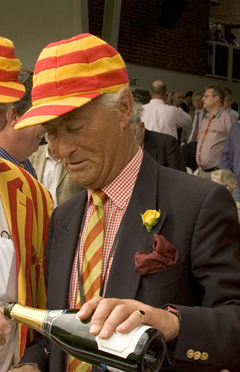
D. Mark Cato