9 July 2009
I was absolutely amazed yesterday when I checked on the statistics for the blog and found that there have been around 25,000 hits since April 16th. There were 10,000 or so requests for pages presumably for people reading the diary or the anecdotes.
I did give the blog some exposure when it started, through my various contacts, at home and overseas but it is still an amazing statistic. I expect the novelty will soon wear off.
Some of the people who have accessed the blog probably came through the MND Association or the Cancer Association, both of whom have included a 500 word profile of me on their respective web pages. In addition I joined patientslikeme.com, at the suggestion of my MND team leader, and completed a profile which I hope will assist other sufferers. Again, I suppose that there have been some hits as a result of that. I do advise anyone with a serious illness to use this ‘patients like me’ webpage as it can provide a great deal help and support from persons suffering from something similar to yourself.
The Cricket Match
The first time I personally experienced leather on willow was on October 25, 2003 on the former military parade ground, Fort Malabar, Cochin, India – the first such match to be played on this ground since 1947 – that is Europeans against the local Indian team, the Cochin Cricket Club, dubbed by us for this game as the Kerala Killers, we being the Great British Geriatric Gentlemen.
I should perhaps explain why and how we came to be in Kererla at all. The culprit was one Jeremy Richard Simon Brinton (pictured on my right below) who together with his delightfully crazy fiancée, Susannah Margaret Smith decided to get wed in St Francis Church, which boarders the northern side of the said military parade. The wedding ceremony caused a minor sensation, being again the first such since independence in 1947. The battery of television cameras, camcorders and digital cameras was worthy of Madonna.

The bridegroom, having received acceptances from 55 or so guests from all corners of the globe, decided to round off the celebrations with the cricket match against the locals. This was a stroke of genius except that he failed to ascertain just how good and keen were these locals. He compounded the imbalance by having absolutely no idea what experience he could call on from his guests. Me for instance. Although outwardly giving the appearance of being a seasoned cricketer – although to be fair I had never claimed to be such – being a very keen long-term MCC member, had never actually faced a ball in any form of cricket match in my life. Again some explanation is necessary as to how I had reached my 70th. year without having experienced the thrill of facing a bowler, who is intent on either removing my stumps or my head! The answer is quite simple. I was such a sickly specimen at school that I had a medical certificate, excusing me from all the physical exertion. The danger of being that the boots holding my feet to my legs would not be sufficient to prevent a severe strain should I trip up. The matter was only remedied after I left school, and my mother relented and allowed my tonsils and adenoids to be removed, which had apparently been poisoning my system for some years. I was then able to indulge in sport, but alas, it was too late for cricket, certainly school cricket.
Back to Kerela. Having accepted the invitation to the Brinton/Smith wedding how could I resist the golden opportunity of catching up with my lost youth and enjoying the thrill of actually playing the beloved game as opposed to being a sedate spectator. However, when I learned that the team we where to play was top of the B division – one of seven such local leagues – some serious thought went into compiling some rules, which would go some way towards creating a level playing field. This is what I came up with:
Rules for Cricket Match at Fort Malabar, Kerela 26 October 2003
The Great British Geriatric Gentlemen (Visitors) v The Kerela Killers (Home Team)
1 The Rules of Cricket shall apply except as follows:
2. The Game shall be limited to 20 overs each side.
3. The Home Team shall not bowl medium or fast balls at any visitor over the age of 40 years. Any such ball bowled shall be signalled as a 6 for the Visitors, thus ( Y ) shall count as a ‘no ball’ from which the batsman cannot be out.. The Umpire shall be the sole arbitor of the speed of the bowl following an appeal by any member of the Visiting side.
4. The Visitors may rest or substitute any team member at any time and as often as they like.5. No batsman may occupy the crease for more than 4 overs and , in any event, must retire immediately he scores 30 runs but may return later to complete the 20 overs, provided no more than 9 wickets have fallen.
6. No member of the Home Team may score more than 2 boundaries per over. Any number over 2 shall cause the score of the Home Team to be reduced by 4 runs and be signalled by a circular motion of the hand above the umpire’s head.
7. No bowler may bowl more than 4 overs.
8. All ‘throw –ins’ shall be under arm. Any deemed not to be by the umpire shall cause the offending team to be penalised 4 runs.
9. No batsman can be out first ball from any new bowler.
In the event it proved necessary to add one more rule when we arrived, and inspected the ground, and noted and number of cows and kids grazing the outfield.
10. Any batsman who strikes a ball, which hits a cow or kid shall be credited with five rounds.
Of course my objective was no more than the blindingly obvious one of wanting to give us a chance of putting on a reasonably good show!
On the morning of the match I woke up in the Residency, on the south side of the erstwhile parade ground, to the shrill cries of excitable youngsters playing football on what was to be our cricket square. The football match ceased and the groundsman appeared to prepare the pitch. He brushed off the dust and rocks, disturbed by the footballers, using a bundle of twigs. The outfield was not cut but was being cropped here and there by the cows and kids which had prompted the late insertion of Rule 10. A wide green coir mat was then laid the length of the pitch and a handsome red posted pavilion with exotic drapes (shamiyana) was then speedily erected on the north side. Finally the groundsman circumnavigated the boundary which he marked with the trail of chalk dust. There then was the setting for the duel to come. St Francis Church to the north, Fort Malabar Residency to the south, the Cochin Club on the west side and some undistinguished buildings to the east.
The Cochin Club is worthy of a further mention as it was here that we congregated for the reception following the wedding, with the bridal group being led in by a phalanx of noisy drummers. This club was clearly the smart place to come in the days of the Raj when I doubt that any member of the darker nation would have been allowed to cross the threshold other than in the guise of servant or waiter.
Following the reception, and as we passed by open windows on the way back to the Residency, I observed a solitary quartet of four elderly Indian matrons playing bridge in a vast card room where once the white memsahibs would have sat, over half a century earlier. A little further on, through another open window, I saw the ubiquitous billiard table, now gathering dust and possibly rarely used where once, no doubt, it had been the focal point on mess nights, billiard fives and all that. An echo of times past, times remembered, fading inexorably over the decades until, if ever, another wedding party, or roving cricket team takes to the erstwhile parade ground to try their luck against the CCC, and then passing through the club, will see nothing but what they see.
So much for the surroundings, what of the pitch itself? I was approached by what I took to be a journalist but what could equally have been a tuk-tuk (auto-rickshaw) driver, cricket enthusiast, asking if I could comment on the ground. I had no great difficulty in finding the bon mot, challenging, I said and then strode on leaving the enquirer to mull that over. In the event it was a fair description. Challenging indeed it certainly was. One third of the ground was hard baked mud, created, no doubt, by half a century of football games – organised, official and ad hoc. Somewhere beyond this mud flat lay the outfield, bare in parts or else covered by tall grass being grazed by the livestock (the lawnmowers!). The boundary ran through this variable surface marked by periodic chalk deposits, leaving it to the honesty of the fielder to swiftly assess whether ball had passed over an invisible line between adjacent chalk heaps some 20 feet apart – nothing as sophisticated as a third or fourth umpire for this match! Indeed whilst mentioning the umpires I should perhaps point out that we ended up with only one although there could have been a second one disguised as a fielder at square leg!
The reason for the sparsity of umpires was that all balls were bowled from the St Francis Church end, for whatever reason I never discovered. As there were no lbw‘s allowed, at least for the visitors, the other umpire was kept busy signalling no balls and leg byes and boundaries as well as the confusing new signals indicating runs to be the deducted from a team which infringed my special Rules. In the event when it came to indicating such transgressions the umpire had his own hybrid signal of four runs to be deducted, an action more akin to a tumble-dryer that had suddenly gone berserk rather than the circular motion of the hand above the head that I had suggested. The scorers, who had all the enthusiasm of the bearded wonder, were understandably confused from time to time and to this day I’m not certain that they ever really faithfully recorded what the umpire was attempting to signal. Where the patches of lush outfield occurred even a well-struck ball had little chance of piercing the boundary and twice the match was in danger of being abandoned altogether through loss of the only cricket ball in this thick grass.
The wicket, as I said, had been covered with a six-foot wide green, coir matting. This had the effect of highlighting the erratic undulations, particularly at the batting end. It occurred to me afterwards that perhaps the home team were not so compliant and accommodating as I had originally thought, indeed possibly quite the opposite. Having received a copy of our rules beforehand I suspect that they had decided to impose Rules of their own in order to swing back the balance. In this case to make us receive from one end only — the end with all the lumps and bumps with which, no doubt, they were all pretty familiar. I should perhaps have listened more carefully when the home captain innocently informed me that we must bowl only from one end. I had brushed this aside without really listening and without realising that this may have been the classic two upmanship ploy – i.e. how to be one up on a oneupman (shades of Stephen Potter).
To round off the scene I should perhaps say a little more about the splendid temporary cricket pavilion which would have gladdened the heart of many a hospitality consultant on an English county cricket ground. Four stout poles were erected supporting a sloping, highly decorative linen or cotton roof – ostensibly this was there to protect us from the sun although in reality it created a furnace below it when compared with the shade of the nearby trees were the semblance of a breeze managed to wiggle in. Beneath this canopy and surrounded by highly colourful and decorative cotton sheets were bright red plastic chairs generally speaking reserved for members of the paler nation. The bulk of the locals disported themselves, again many on red plastic chairs, or on the grass, under the shade of the adjacent trees.
Seated at the eastern end of this canopy and pavilion were the two scorers who took their duties immensely seriously and whose anguished cries rang out from time to time ‘who is the bowler’? Did I mention that the temperature was nearer 30°C than 25°C and heaven knows what degree of humidity, but certainly high. Indeed, it may well be that this high humidity saved the life of at least one or more of our alcoholically pickled visiting team some of whom I saw consuming a perfectly good bottle of Chivas Regal only a few hours before they snatched two to three hours sleep ahead of the onset of this great match. Thus was set the scene for the fierce battle to come.
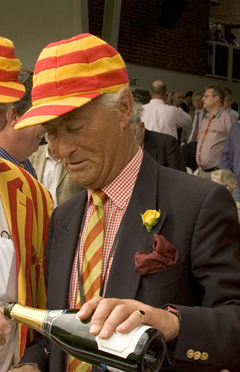
The home team were immaculately turned out in whites whereas the visitors, excepting myself, were a motley crew in shades of white and grey with trousers of variable length and bagginess. As the doyen of the visiting team, in terms of age at least, I bedecked myself in a 1920s style brightly hooped MCC cricket cap with a new MCC tie to match. My existing tie being too badly stained from the Bolly of many seasons at Lord’s, not to mention the occasional dropping from an odd curried egg roll. My lower half was clad in plus fours or more correctly plus twos, as they were rather longer in the leg of than plus fours, crowned below between trouser and shoe with my best harlequin coloured socks, sadly not available in MCC colours.

Thus adorned the spectators could have no doubt who was the self appointed but, believe me, reluctant, figurehead. All decisions between captains, scorers and umpires being referred to me. I suspect that the word was out that I was some ancient giant of the game, probably dating from W. G. Grace’s era, and thus to be deferred to on all occasions. Goodness knows who they thought I was, probably even they did not know but nevertheless the authoritative (and as you, dear reader, are aware and they were not) yet totally inexperienced air, was sufficient for their purpose.
So to the match itself. I had already determined that we must bat first and therefore win the toss. Dutifully, I spun a rupee coin. Our captain called tails. The coin, now resting on my left hand and carefully concealed by my right, not showing any of our gracious Queen’s profile I took to be tails and so declared without protest. Had the home team being put in first I envisaged they would have exhausted our hungover wedding party by batting through the entire 20 overs knocking up an impossibly high score which we, as visitors, would have no chance of surpassing. My way round this dilemma was to get our 20 overs in first and then the home team I assumed would quickly knockoff our miserly 20/30 rounds, which I anticipated, incorrectly as it turned out, would be all that we would muster. If I was correct in my analysis our agony would not be prolonged too long under the intense heat of the midday sun and we could all adjourn, at a respectable hour, to the nearest hostelry for well-deserved sustenance.
Our captain bridegroom opened with his best man James Grant-Morris. This pair acquitted themselves very well in the 4 overs allotted to them. The captains scoring 10 runs from 13 balls before he was run out and young James, holding up his end well, adding a modest 4 runs to the score, having faced 12 balls. It was then all change. The two fresh batsmen Fraser Slater and Bromley Oldfield taking the field. Fraser lasted only 7 balls before he was caught. Bromley, on the other hand, played a magnificent innings retiring, not out, after his allotted 4 overs, with a handsome score 41 runs from 31 balls. Then another wedding guest Jeremy Kilpatrick took the crease and scored a creditable 15 runs from 15 balls before being caught in the slips. Graham Millar was next stumped after 11 balls having scored 5 runs with Mark Taylor caught in the cover with 2 runs to his name after 6 balls Alistair Castle and James Exelby were next in both facing only 2 balls before the long trudge back to the pavilion. Alistair managing to break his duck before he was caught and this James unfortunately did not, before he was clean bowled. At this point of the game we were 120 for 7, which I considered to be a very respectable score, certainly far in excess of my most optimistic expectations.
I had elected to bat at 11 but captain, in his wisdom, decided there was at least one person likely to be less competent than I, so put me in at 10. I disdained the greying frayed, mismatched pads which the home team had kindly provided. Anyway pads and plus twos are not sartorially comfortable with each other. I would have liked a cricket box but this was a piece of very personal equipment not provided and not the sort of thing that one would think to pack. Whether or not any of our young men had secreted the protective equipment into their own underpants and were too sensitive to offer to pass this lifesaver from sweaty crutch to sweaty crutch, I know not. All I know that I was to take guard unprotected in the vital area.
Accompanied by wild cheering, both from the pavilion and spectators from under the shade of the trees, it was announced, to the delight of the crowd, that ‘Professor Mark Cato age 70 will bat next’. I was not 70 years old but nearer 69, however six score years and 10 sounded much better than 69 in publicity terms. So 70 it was. An innocent enough hyperbole considering the event, the day, the setting and the crowds excitement on hearing that someone twice the age of the next youngest visitor was going out to bat. Our team ranged in age from late twenties to mid-thirties and the home team, barring the ageing captain – late forties early fifties – ranged from 15 years old to mid-twenties.
I strode to the wicket, heart pounding, with the cheers of the crowds echoing encouragingly in my ears. My partner was our captain who had come in again, having retired earlier under Rule 5 after 4 overs. This time he added a valuable 15 runs to our score. Suddenly I was facing my first ball ever. Firstly, I took guard, a comic sight already or at least eccentric. I played to the gallery. After firmly planting my monocle in right eye I asked for middle and off. How to mark the spot? The coir matting, with its wobbly chalk line marking the crease, by now almost obliterated, making runouts and stumpings very questionable, helped me not at all. The wicket keeper ultimately coming to my rescue by deposited a pile of chalk dust in roughly the right spot.
The wicket, as I said, had been covered with a six-foot wide green, coir matting. This had the effect of highlighting the erratic undulations, particularly at the batting end. It occurred to me afterwards that perhaps the home team were not so compliant and accommodating as I had originally thought, indeed possibly quite the opposite. Having received a copy of our rules beforehand I suspect that they had decided to impose Rules of their own in order to swing back the balance. In this case to make us receive from one end only — the end with all the lumps and bumps with which, no doubt, they were all pretty familiar. I should perhaps have listened more carefully when the home captain innocently informed me that we must bowl only from one end.

Remembering 60% weight on the front foot, I reminded myself, straight bat, don’t hang it out dry and be ignominiously caught behind or in the slips as I have witnessed so many times at Lord’s. Due to my advanced age it was decided to bowl to me underarm, kindly meant but nevertheless an insult, but who was I to argue! The first ball, which was free, in as much as by Rule 9 I could not be out from it, shot across the coir matting at the speed of a giant Anaconda intent on snatching its prey. It went by so fast that despite all of my skills as an erstwhile polo player, able to strike a moving ball from the back of a galloping horse with a flimsy 52 inch stick, I was unable to get anywhere near this fast moving target with a stumpy bat half the length of my polo stick. In fact, I was surprised at how heavy was the bat. Thus, my dream of an opening boundary was shattered.
After a plea from me the bowler reverted to normal overarm but the moment had passed. I chipped at the next ball outside the off but not far enough to risk a single. I then had to change ends with my captain, it being over. J. B. struck a couple of spirited blows which left me huffing and puffing up and down the pitch as we garnered more runs. After another over I was on strike once again. I managed a couple of mildly copybook shots, both of which were non-scoring, before I let loose with a fine blow straight into the safe hands of long off.

I trudged back to the pavilion, defeated but not bowed, to the wild cheers of the assembled crowd. My first game then was over, well almost. Later, when we were fielding the captain used Rule 4 literally to ensure that I did not have to spend too much time in the field under the fearsome sun. With a duck to my name I wonder if this qualifies me to join the Radio 4 Primary Club – I must drop an e-mail to Blowers.
The match continued and far from being skittled out in half a dozen overs the gallant Great British Geriatric Gentlemen continued to build an impressive score, 129 for 9 before their 20 overs expired. I will draw a veil over the home side’s innings but suffice it to say that at one stage it looked as though we might win. It became quite clear to me that the alcohol was wearing off and our young men had their tails up. They could see a win in sight. This would have been totally unacceptable under the circumstances, particularly as we had seriously knobbled the home team with our special Rules. So serious were our team that they even refused to allow the versatile young bride Susie from bowling which she was very keen to do. I sent out clear instructions to our team that they were definitely not to win. Whether or not this had any effect at all I cannot tell other than to say that there was a very satisfactory conclusion when the home team passed our score in their 19th. over.
The traditional cricket tea took place in the Malabar House Residency – samoosas and rather thicker than normal cucumber sandwiches. Shades of the Raj still. Some things never change. Thank the Lord.
To celebrate my 70th birthday, one of my cricketing friends from Lords, John Fawkes, wrote and declaimed the following tribute to that match. Make of it what you will!
“MARK CATO’S CRICKET CAREER
When Mark was a young man his health was very bad
He couldn’t play like the rest of us, and this made him very sad
He never learnt the noble art of playing with a ball
He couldn’t bat, he couldn’t bowl and he couldn’t field at all.
But he loved cricket and many years ago, you see His love was requited: he joined the MCC.
To Lords he wart loyally year by year
Evan when it rained— he would always appear.
Supporting England, hosting guests, enjoying the scene Drinking champagne, smoking agars, always very keen.
But he never played the game until his 70th year
Now a learned Professor with absolutely no cricket gear.
How did it happen this incredible initiation
Well it happened with the full co-operation of part of the Indian Nation
Two young friends of Mark decided to get wed in an Indian City
It was so far away it seemed rather a pity.
But 55 guests flew in from East and West
For these Indian Celebrations promised the best.
The wedding Ceremony caused a sensation
Watched through a battery of television cameras by the astonished Indian Nation
This was the first wedding in the Church since 1947
And moreover the groom had challenged the Local Cricket X1.
The two elevens met on October 25th 2003
The temperature was at 30 C so Mark rested under a tree.
He wore plus 2’s and MCC cap and tie—nothing white
He certainly looked an amazingly eccentric sight
However, Professor Mark insisted on writing the rules for this 20 over match
The locals agreed and here was the catch
The home team was restricted in the runs each could score.
They could only bowl 4 overs each— but nothing more.
Mark ‘stitched up’ the rules so his eleven could do well
The Indians seemed to be under his spell.
They agreed to him being the rules making boss.
They even agreed when he fiddled the toss!
So first into bat went Mark’s team; they did very well
But batting in the heat was sweaty as hell.
So Mark sat quietly under his tree
Waiting at No. 9 for his cricket destiny.
At last it came at 120 for 7
Mark was now in this cricket heaven
To the wicket he strode with his bat in his hand
The crowd cheered; a rousing tune came from the local band.
Having inserted his monocle Mark took guard
Middle and off he said and thought the wicket looked hard.
A boundary on his first ball he wanted to hit
But unfortunately he didn’t get within a mile of it
Mark’s captain faced the next few balls
And they even managed to synchronise calls.
But Mark once again faced the foe.
He struck a huge and mighty blow
Was this the boundary to which all hats would doff
No, sadly the ball was caught quite brilliantly at ‘Deep Mid-Of.
Back to the pavilion he trudged defeated but not bowed.
His progress madly cheered by the watching crowd
A duck in his ever first cricket game.
It really was a terrible shame.
All out for 129
Now to bowl out the home opposition and in good lime.
The rules that Mark had set out at the beginning
Made it hard for the home team to contemplate winning!
The Indians were nearly beaten at one critical stage.
But Mark intervened as the wise old sage.
We must let our hosts win at any cost
And so on Mark’s instructions the game was lost
But the goodwill created obviously appealed.
For the locals cheered Mark’s team off the field.
And so ended Mark’s short lived cricket career.
Which did not start till his 70th year.
But now at Lords on a sunny bright day
He can talk about playing in India far away.
No longer an onlooker and for a very small sub.
He can now join ‘Blowers 4 Primary Club.
If by chance these lines
Are read by one who in
some common room
Has had his bluff called,
let him now take heart.
John Betjeman
Cricket Master – an incident.”

2 July 2009
Today I had my quarterly MND assessment at Addenbrookes Hospital Cambridge. Having explained the deterioration in my hands and arms the doctor was not surprised and said, on the whole ‘I was doing very well’. In other words, I am going downhill pretty much at the rate that they anticipated (although of course, he neither hinted at more, or said such a thing; it is just my own personal interpretation.)
My Forced Vital Capacity (FVC) – blowing into a little handheld device -was 10% down on last time, in the supine position. The support nurse did not think this was significant but she obviously was sufficiently concerned to say that I should perhaps go to Papworth Hospital for a more detailed check. I believe this test is one that indicates your overall rate of deterioration more accurately than any of the others. Having said that the doctor examined my tongue and told me that, at present, the disease was not attacking my throat, so I really don’t know what to think.
One good thing that came out of assessment was that the doctor agreed there was a possibility I could still go to China in October. In other words, my flailing arms may not have completely given up by then. He suggested a further assessment in early September when a final decision can be made.
A team of people came in to the consultation to look at the feeding device and appeared to be very impressed. They included a dietician, an occupational therapist, a physiotherapist, a lady running a hospice and the engineer. The frame still needs a tiny adjustment on the armrest but once that’s done I believe it might be possible to have it tested within the hospital itself and then perhaps trialled in an NHS care home.
Enough boring stuff I think it’s about time I added another anecdote. With the Ashes starting next week (cricket against the Australians for those few people in the world who haven’t a clue what I’m talking about), I have added to Anecdotes The Cricket Match, which I hope you all find amusing.
1 July 2009
One of my readers, for whose opinion I have the highest respect, suggested that this blog would be more useful to patients and carers if I were to be more honest about my feelings. I’m perfectly happy to do so but, of course, do not want to fill these pages with doom and gloom. That’s why I usually concentrate on the jollier aspects of life.
It would be totally dishonest if I did not admit that I am anxious much of the time about my condition, most particularly, I suppose, in bed at night if the fasciculations are very active. One lies there knowing one is going downhill, but how fast? Beyond that I do not believe that I am seriously depressed.
The worst aspect of this condition is the overall sense of weakness and increasing frustration in being unable to do things with one’s hands. Yesterday, for example, I almost failed to get out of the train because I could not exert enough pressure on the door ‘open’ button, which I eventually managed to do with my elbow.
The other great frustration comes in handling paper. Sorting out files and so on and the absolute impossibility to grip single pages. I can still manage my laptop with my hands using the middle finger of my left hand to operate the mouse. In addition, I have a lever Point It! mouse, kindly provided by AbilityNet, which I also use. When the hands go I shall have to revert to a foot operated mouse which will also be provided by AbilityNet. Having said I manage with my laptop, again I find the process extremely frustrating. Everything is so much slower now.
Beyond all of that I live day to day and do not give too much thought as to how I might end up. If I did well on this I’m sure I could become extremely depressed. It is for that reason that I include, in this blog, urbane details of unaccompanied visits to London, Lord’s, the golf club and the like. Not to impress the reader about how sociable I am but just to demonstrate my physical ability for activity.
I hope that this satisfies the reader who wanted to learn more about my emotional state of mind.
25 June 2009
I am due to have my quarterly MND assessment on 2 July when I will finally be able to make up my mind whether I am likely to be fit enough to go to China and give my lectures in October. It all depends how much further my hands and arms weaken in the meantime. I noticed, particularly in bed last night, what difficulty I was having pulling back the bedclothes. I had to use a combination of closed fists and elbows. Also, getting up from the floor following my morning exercises, the only way I can now manage it is to get onto my elbows. Strangely enough my right hand is now more useless than the left but the arms are the other way around.
Feeding is OK as long as the food is cut up, I can use a spoon. Most drinking is through a straw as most glasses are too heavy for me, although I can still cup a wine glass. Driving is fine in my automatic as I can still curl my fingers.
My greatest fear is getting locked into a public lavatory – in the train or in someone’s offices. Locks with a circular knobs are the worst.
22 June 2009
Another beautiful summer’s day and walk around at the geriatric golf meeting. I managed the 18 holes with regular rests on my shooting stick.
21 June 2009
The World 20/20 Finals at Lord’s today. The English ladies won comfortably. Sadly our men were not in the final, cheated by the weather and Duckworth Lewis. However Pakistan put up a great show and beat South Africa who were the favourites.
18 June 2009
To of my oldest friends came to lunch in the garden today, Geoffrey and Jessica Hanscomb, both in their 90s and in splendid form. I am supposed to be Geoffery’s executor but it looks more likely to be the other way around.
17 June 2009
Toenail day at the Community Hospital. A nice podiatrist who unfortunately confines herself to feet. The local doctors’ surgery do not wish to know about fingernails which I certainly cannot manage myself but I am fortunate that Alice is prepared to have a go. Having said that I’m going to try to find out what would happen if I didn’t have this option. I believe the Red Cross or Help the Aged offer some sort of service.
16 June 2009
Sadly England were knocked out of the World Series, by the West Indies, last evening in a rain interrupted match.
I do believe my hands are getting weaker. I’m still managing to shave lying down but need both hands on the razor. Also can still manipulate my electric toothbrush, but only just. How long will it be before ’my lovely’ will have to do both for me?
The interesting thing is that it seems to me that my right hand is weaker than my left although it’s the other around with my arms. Whether this is because I constantly use the right-hand rather and the left I shall have to ask at my forthcoming quarterly assessment. I know the right-hand is getting much worse – it goes like jelly – and it can take several minutes controlling it on a stiff piece of card containing the daily crossword puzzle. Only then, once it is in position can I actually scrawl in the answers.
Alice already has to fill in my cheques for me and indeed sign them. I had better not fall out with her otherwise I might find my account cleaned out!
The occupational therapist has kindly fitted some rather hideous plastic caps onto our bathroom taps. The ones on the X shaped heads work well but the lever caps on the round headed taps are a little awkward.
All of this gradual weakening means that the possibility of me being able to go to China to deliver my annual course of lectures, in October, is probably receding fast. Obviously I will know better in early July after my assessment but to be honest, lovely people though they are, they don’t seem to have much idea about timescale. The standard explanation, usually given, is that everyone is different so it is virtually impossible to say how fast one will go downhill and in what direction. Of course, they can take an educated guess, and are usually prepared to do so if pressed. This guess may be reasonably near the mark, but I am still not convinced however that they could not be far more scientific about the whole process and do what I came up with in the early stages of my diagnosis: that is to carry out weekly, or monthly checks with scientific instruments, grip handles, strengthen levers etc. – which I know are available – and from that be able to plot some sort of ‘slope of deterioration’. These checks could be carried out by the patient, or their carer, at home, provided the equipment was made available. Even if the results were wildly different with every patient then they should question why, and perhaps ultimately be able to draw some conclusions from the differences.
D. Mark Cato
D. Mark Cato