30 January 2010
I didn’t have a bad night’s sleep having taken a couple of painkillers at 2.00 a.m. I can now assess the damage from yesterday’s fall. Apart from a large piece of skin scraped off the skull; a sprained left wrist and a stiff neck which I hope is no more serious than that, I clearly got off lightly.
Overnight more snow and the garden was transformed into a magic fairyland once again, set off by a beautiful sunny day with blue skies. This ‘good to be alive’ sort of day prompts me to add  some more inspirational material and a few more jokes, first of all the jokes.
29 January 2010
Richard, my web designer,  came to lunch today to instruct me on making my own entries on the blog. It all looks quite complicated but provided he gives me a line by line ‘mugs guide’ which he has kindly agreed to produce for me, I should be able to manage.
As Richard was about to leave, I slipped in the garden and had a nasty fall, smacking my head on the wall of a house and splitting my lip. I think it was more to do with MUD than from weak legs from MND!
Fortunately, I don’t think I have done any permanent damage, despite having a very painful neck. I will know better tomorrow morning when I wake up.
A belated Christmas card arrived today with a very welcome £25 M and S voucher  from the local MND Association – how very generous of them.
28 January 2010
I fitted the lycra gloves this evening whilst I was watching television, intending to wear them overnight but I abandoned the right-hand  glove before retiring. After wearing it for a couple of hours the muscles in the palm of my hand and on the back,  both ached rather painfully. I am clearly going to have to take it slowly and build up the length of time that I wear these gloves.
27 January 2010
I had my lycra gloves fitted at Addenbrookes Hospital today. My initial impression is that whilst giving a certain amount of support to the wrist, at least, the downside is that they restricts what little grasp I have left. In other words,  it is more difficult for me to curl my fingers towards the palm. However, what the gloves do is to straighten out the fingers and I will probably sleep in them for a week or two rather than trying to wear them during the day. I believe it is a well-known medical fact that the more fingers are curled the less likely it is that one can straighten them. So it seems logical to me that if I can stretch them, say over night, in a virtually horizontal position, that could give them a slightly longer useful life, although no one seems to know whether that will actually be the case.
This week has seen two landmark cases in the ‘assisted suicide’ debate. Kay Gilderdale, who was by all accounts, a devoted mother, assisted her daughter to end her life with tablets and morphine. This, after the sick daughter had attempted suicide and failed. This loving parent could not bear to see her daughter suffer any longer and she walked free from the court with a suspended sentence after being charged with, not just attempted assisted suicide but also  attempted murder.
Compare this with the case of the woman who injected her brain-damaged son with a lethal dose of heroine as she could not bear to think of her son suffering any longer, this despite some encouraging medical prognosis. This devoted mother was sentenced to a minimum of nine years in prison for murder.
These cases have opened up the whole issue of the ‘right to die’ and ‘assisted suicide’.
The reason for the seemingly harsh sentence, handed down by the court for the mother of the brain-damaged son, was that he was not in a position to indicate that he had an intention to die. These cases together with the more recent cases in the High Court on assisted suicide make it even more imperative for the government to consider a change in the law.
26 January 2010
My first walk round the golf course for over seven weeks – Christmas, New Year and the severe winter weather intervening. I was curious to see how I would manage as IÂ really felt that I had weakened over this period. In the event I managed 13 holes and believed I could certainly have completed the round.
Thank goodness my legs are holding up better than my hands and arms. I am finding it increasingly difficult to do my morning exercises; to manipulate my electric toothbrush and to shave with my electric shaver — even with the  purpose made pouch which I have had made to clamp it to my right hand. In fact, I am beginning to dread all of these early morning activities as they have become stressful but I’m determined to continue to do them on my own as long as I possibly can.
The thatchers arrived today with all their paraphernalia. This is the full Monty this year, a completely re-thatch of the house and the office – horrendous expense, but we have no choice. This has to be done every 25 years or so with a re-ridging in between. In no time at all they had stripped off half the roof and remove tons of old straw, exposing a fairly fresh layer, before they started to apply the new long straw, something in the region of 16 to 18 inches thick. This job is meant to take three weeks.
23 January 2010
Despite slightly panic stricken telephone calls from my sister-in-law in Cornwall concerning my dear mother-in-law’s deteriorating state of health – she will be 99 years old at her next birthday, after all – we decided to go ahead with another arranged social event and had Jill and Tony Griggs, wincing each time the telephone rang, thankfully usually spam call but fortunately no dramas. Again, the house provided a welcoming glow and more Bollinger was consumed.
19 January 2010
I caught the train to London today for the first of this year’s meetings of the Kings College branch of the Arbitration Club. Fortunately, like the Mother Club the meetings are held, at a solicitor’s office, just behind Liverpool Street Station, so  the journey was not too exhausting.
18 January 2010
We received a very welcome telephone call from Richard today. He has been released from hospital with a relatively clean bill of health. At least that’s his version of it! (They’re a tough breed these old naval types). We will just have to keep our fingers crossed (and everything else!)
Jodie, from AbilityNet, came today to instruct me in the further use of voice activation on my laptop. I really must try to avoid the temptation of using the one finger that still works and see if I really can carry out the whole process by voice. He also set up my Sony E reader which will be fine as long as I can still press the buttons.
However, I gather that there are a number of new types of E-readers coming onto the market in the next few months which, hopefully, will be able to be operated by voice or foot.
Speaking of gadgets I have certainly not given up on the idea of my own feeding device or bionic gloves. I have been given some new contacts through the Disabled Living Foundation and at least one of these is looking promising.
17 January 2010
Last evening, we received the telephone call that we have dreaded for some time. My mother’s 90 year old husband, Richard, (is he my stepfather once removed!?) was taken to hospital with a minor stroke — the second in two days. Fortunately, we have some very good friends in the area, indeed, I have known John and Anne Prytz since they both got married at 19, some 57 years ago. Anne is kindly holding the fort, looking after my mother and awaiting the outcome of the hospital tests. We will then have to decide what to do from this end.
I’ll say no more about the South African test match other than that it finished a day early with an ignominious defeat for England.
On early Sunday mornings, on Radio 4, Mark Tully frequently broadcasts a thought-provoking programme called Something Understood.This week the topic was Absolutely Honest from the New Unique Broadcasting Company Ltd. In this programme Mark Tully asks if absolute honesty is always the best policy and questions the philosopher, A C Grayling, about his suggestion, that dishonesty can sometimes even be virtuous. I advise my readers to listen to the whole of this broadcasts themselves, if they possibly can, but I reproduce here a couple of extracts which I found particularly interesting which, of course, should be read in the context of the whole discussion. The topic was particularly interesting to me, in particular, as to how honest you are, or should be, with someone who is diagnosed with perhaps, say, a terminal illness. Let’s make the proposition even more difficult and say it was a very young person who has been diagnosed with an incurable disease and has only months to live.  First of all then, there was Eleanor Brown’s amusing, if somewhat unkind poem, on the subject of honesty, Bitcherel
You ask what I think of your new acquisition;
and since we are now to be ‘friends’,
I’ll strive to the full to cement my position
with honesty. Dear – it depends.
It depends upon taste, which must not be disputed;
for which of us does understand
why some like their furnishings pallid and muted,
their cookery wholesome, but bland?
There isn’t a law that a face should have features,
it’s just that they generally do;
God couldn’t give colour to all of his creatures,
and only gave wit to a few.
I’m sure she has qualities, much underrated,
that compensate amply for this,
along with a charm that is so understated
it’s easy for people to miss.
And if there are some who choose clothing to flatter
what beauties they think they possess,
when what’s underneath has no shape, does it matter
if there is no shape to the dress?
It’s not that I think she is boring, precisely,
that isn’t the word I would choose;
I know there are men who like girls who talk nicely
and always wear sensible shoes.
It’s not that I think she is vapid and silly;
it’s not that her voice makes me wince;
but – chilli con carne without any chilli
is only a plateful of mince…
I do hope that Mark Tully, for whom I have the greatest admiration, and Prof Grayling, will forgive me for paraphrasing their very interesting discussion and hopefully getting somewhere near the honesty they were trying to demonstrate. If there is any ambiguity in what I say, I can only plead with the reader to access the actual discussion for themselves.
Two researchers at Brunel University have suggested that there is no consensus in our society about ‘ What honestly is’. Asked to comment on this, A C Grayling wrote an article entitled, Don’t Dismiss Dishonestly It Can Be Virtuous. Grayling defined honesty ‘as the sincere attempt to stick to the truth, to tell the truth, to act with integrity, to deal with others fairly and justly’. He emphasised the importance of sincerity with the interests of others in mind. Mark Tully suggested there must be times when you honestly feel, you sincerely feel, that it is not right to tell the truth. Prof Grayling said he particularly liked what the Church of Scotland says, that there are times when to tell an untimely truth is a sin and suggested that you can do a great deal of harm to tell someone the truth at an inopportune moment. Take a simple example, suppose you’re halfway through a dinner party and your spouse says to you, ‘ how do I look’ and you think they look absolutely ghastly, this is the right moment not to say that.
So it can it be virtuous to be dishonest sometimes, provided the concept of sincerity is always present. So the corollary of this is, there are times when it is not right to be honest, even when you are asked for it or, it can be untimely tell the truth but sincerity can be very helpful too.
This extract from Anne Frank’s diary shows just what a tangled tale the business of honesty is:
‘Oh my, another thing item has been added to my list of sins. Last night I was lying in bed, waiting for father to tuck me in and say my prayers with me, when mother came into the room, sat on my bed and asked very gently, Anne, Daddy isn’t ready, what if I listen to your prayers tonight? No, mumsie, I replied. Mother got up, stood beside my bed for a moment, and then slowly walked towards the door. Suddenly she turned, her face contorted with pain, and said, I don’t want to be angry with you I can’t make you love me. A few tears slid down her cheeks as she went out of the door. I lay still thinking how mean it was of me to reject her so cruelly but I also knew that I was incapable of answering her any other way. I can’t be a hypocrite and pray with her when I don’t feel like it. It just doesn’t work that way. She cried half the night and didn’t get any sleep.
Father has avoided looking at me and, if his eyes do happen to meet mine, I can read his unspoken words .How can you be so unkind? How can you make your mother so sad? Everyone expects me to apologise, but it’s not something I can apologise for because I told the truth and sooner or later mother was bound to find out anyway’.
Mark Tully suggests that there is a niggling feeling within us that makes us feel uncomfortable when we are dishonest. This discomfort is beautifully illustrated by Georgina Blake’s poem The Teacup Storm
When the seed
of honesty
fell
to
me
I should have walked straight by
Trampled it not heard its cry
The seed
of honesty
fell
to
me
I kicked it around
For I knew it instantly
I could not bear to hold
it in
my hand
For there was
my tomorrow
my wish
my dream
my sleep
my scream
my yesterday
The seed
of honesty
fell
to
me
As love
I could not eat until it
was planted
safely
buried
secretly
watered
Then as if by torrential tropical
sudden rain
It sprang to life
Cast a shadow by
my window
Tempting me to pick its fruit
a snow white
rosy red
Once bitten would turn
black
Trapped as Jack was I
In the giant’s lair
Its aromatic taste told not
of what would be
until it flowered
Gently
guillotining
my
existence
The seed
of
honesty
fell
to
me
Then I could see
How…one person’s laughter is despair
in another’s eyes
How …even with one word a page
may stain
How … from a tiny drop of rain
storms rage
Why was this seed not taken by bees
Driven by seas
Scattered
by
winds
Why fall
to
me?
Why?
When the seed
of honesty
fell
to
me
I should have walked straight by
Trampled it not heard its cry
The seed
of honesty
fell
to
me
Then I could see
How from a tiny drop of rain
storms rage.
So there we have it, the moral dilemma of when dishonesty may be virtuous and the guilt that can be associated with it.
Today, Sunday, was a particularly sociable one as we had arranged for Ali and Graham Mackrell to come and have a drink at lunchtime and Jane and Kit Orde-Powlett in the evening. Despite the potential problems on the home front with Richard, we decided to go ahead in the hope that all would be well, as indeed proved to be the case. Lantern Thatch was looking at its best. The iconic Christmas card thatched cottage with a blazing log fire glowing on the ancient oak timber framed sitting room – a welcoming sight. Much Bollinger was consumed.
16 January 2010
The third day of the fourth test match against South Africa started with the home side being 215 for 2, against England’s abysmal 180 all out yesterday. Our captain, Strauss, was out first ball which  rather set the tone for the rest of the innings. Then, there was the added complication of the South African opener Smith, clearly being out at 15, and the review umpire failing to notice that he snicked the ball and,  as a result, wrongly failed to give him out. Smith went on to score 105 which may well have sealed England’s fate.
Whilst I was finishing reading a fascinating book entitled Yemen by Tim Mackintosh-Smith, which broadly covered the period that I spent in southern Arabia in the late 50s early 60s, another book arrived, this from my kind brother-in-law, Col. John Garton-Jones. Amazingly, this book was also about the same region and the same time period. This book, Roads to Nowhere – a Southern Arabian Odyssey, was written by an old mutual friend, John Harding, you was a member of the Colonial Administrative Service and acted as an Assistant Political Adviser in the Eastern Aden Protectorate, as an administrative officer in Aden and finally as a Political officer in Lahej and Radfan. It really looks an interesting book and I shall enjoy reliving old times through its pages.(My lavatory book at present is a tiny volume by Alan Bennett, Clothes They Stood up in.)
D. Mark Cato
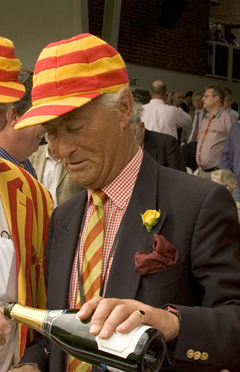
D. Mark Cato